5 - Gravity |













Here we consider how gravity can be explained as a manifestation of 4D aetheric waves.

Gravity as a 4D Wave Phenomenon
Modern science is still not able to
give a convincing explanation of how gravity works. It struggles to explain how
two bodies can pull on one another at large distances.
The conventional view involves the rather peculiar notion that gravity results
from an exchange of particles (the as yet unseen gravitons) between the
planetary bodies.
We think that there is a much simpler and conceptually more satisfying
explanation for gravity, which involves the idea of a push or shadow effect.
If a force is transmitted to a body from 'something' pushing on it from all
directions the body would remain stationary as all the forces would cancel out,
Fig 5.1a.
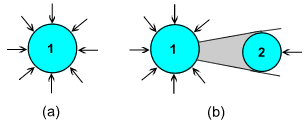
Fig 5.1 The shadowing
effect of two bodies resulting in an 'attraction'.
However if a second body is brought close to the first one, part of the
impinging force on body 1 would be blocked out and cause a net push towards
body 2, Fig 5.1b.
Similarly body 1 would cause a push on body 2 towards body 1, resulting in what
would appear to an observer to be an attraction between the two bodies.
This idea is not new, it has been proposed by a number of people, one of the
earliest of which was La Sage [1]. He showed that the amount of
shadowing produced is proportional to 1/r2, where r is the distance
between the two bodies. This is consistent with the 1/r2 variation
of the gravitational force.
However we will not assume, as La Sage did, that the impinging force is caused
by the bombardment of particles or gravitons or aether particles in our case.
This type of assumption leads to other difficulties, such as the resistance and
slowing down that this would cause to an orbiting body and incompatibility with
inertia.
This is the fundamental flaw of all 'pressure' based gravity models -
inconsistency with inertia. That is, if gravitational attraction is to be
considered as an imbalance in the pressure due to shadowing it implies that any
object moving through the aether will experience a greater pressure in the
front compared to the back. It would therefore experience a resistive force
even if moving at constant velocity, contrary to experience.
We will adopt here the model outlined by Maurice Cooke which explains the push
on the bodies to be a consequence of the shielding of 4D waves [2]. That is,
aether waves along the 4th dimensional axis as described in the Matter section.
The very same waves that in the aether model are responsible for the creation
of particles, giving us a way of unifying gravity and quantum mechanics.
As described in the Matter section, 4D waves are
generated by 'primary' points and appear in 3D space as spherical waves
travelling in all directions.
Close to a planetary body the waves from the opposite end are blocked by the
planet causing a change in the resultant interference pattern, or points
of low and high vibration surrounding the body.
In such a situation the superpostion of waves will produce a general drift of
nodal points towards the body. The best way to illustrate this effect is with a
computer simulation.
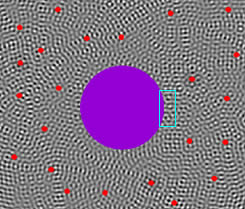
Fig 5.2 The interference
pattern from spherical wave generators (red points)
sorrounding
a spherical body.
Fig 5.2 shows the arrangement used in the calculation. The purple sphere
represents a planetary body. The red dots represent a more or less randomly
distributed collection of 3D spherical wave generators. The black and white
areas show the interference pattern produced by superimposing all the
individual contributions.
Of course this is not to scale. In actuality the waves would be of a much
smaller wavelength, of the same order as atomic distances, but the principle
would be the same.
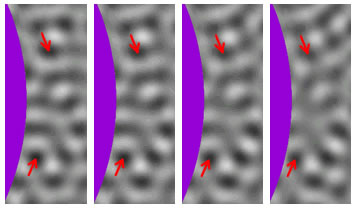
Fig 5.3 Series of
images showing the nodal drift towards a planetary surface.
The
time interval between images is ~5% of the wave period.
Fig 5.3 shows a magnified image of the rectangular region in Fig 5.2 as it
develops over time.
Although there are small changes in particular areas of the pattern due to a
time evolution of wave amplitudes, the overall structure of the pattern remains
intact from one image to the next.
As the highlighted points show there is a general movement of the recognizable
structures towards the spherical body. The drift being greater the closer one
gets to the surface.
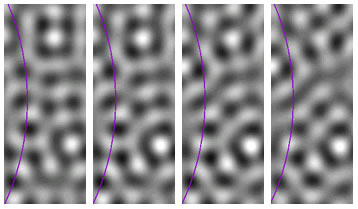
Fig 5.4. Same as Fig
5.3, but without the planetary body.
Fig 5.4 shows the same area when the spherical body is not present.
As before there are small changes due to a time evolution of waves but there is
clearly no movement in the structure of the pattern.
As discussed in the Matter section the nodal points in the 4D wave pattern,
corresponding to low vibration areas in the aether, are the points where matter
particles condense out of the aether.
If we further assume that the particles once formed have a tendency to 'stick'
to low vibration nodal points we can see that the nodal drift near a planetary
body will exert a force towards that body on any objects in the vicinity.
When a second body is brought close to a planetary body it will block out some
of the waves normally reaching it, as in Fig 5.1(b). This will result in a
smaller nodal drift, and therefore a smaller force, on the side facing the
second body. The side facing away from the second body will still have the same
nodal drift and therefore push.
The result of all this will be to produce a net force on the first body towards
the second. By a reciprocal argument there will be a net force on the second
body towards the first.
The amount of nodal drift near the planetary surface will be dependent on the
amount of 'shadowing' from the other body.
Given that the amount of shadowing follows a 1/r2 relationship [1]
the present model would be consistent with the 1/r2 variation of the
gravitational force.
This model also explains why all objects fall towards the surface of a planet at the same rate independent of shape, mass or density. The nodal points at a particular radius all drift towards a planet at the same rate giving an equal 'push'.
This model also accounts for the breaking up of large objects, such as large
meteors, as they hurtle towards a planet.
Because the nodes are drifting towards the surface of a planet they get
progressively closer due to lateral shrinkage. This lateral shrinkage will
squeeze the object perpendicular to the line of the nodal drift, Fig 5.5.
The larger the object and the faster it travels the greater the lateral force.
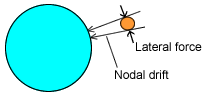 Fig 5.5 Compression forces on a falling body.
We should also note that the 4D waves are unlikely to be completely
blocked at the surface of the planetary body. It is probable that they will
penetrate some way into the body, with a diminishing amplitude.
The 4D waves might actually exit the other side with a much smaller amplitude,
particularly for smaller bodies, and
possibly a phase shift due to the waves slowing down inside the body in a
similar way light does when it goes through a denser medium.
In either case the net effect will be the same, a drift of the nodal points
towards the body.
One of the other implications of this assumption is that above a certain planet
size the 4D waves will be completely blocked from exiting the other side.
Therefore when a planet volume goes above that size the increase in shielding,
and therefore the gravitational pull, will not go up in the same way as it did
below that critical size.
Amazingly there is good evidence for this type of behaviour in our own solar
system as shown by Stanley V. Byers & Michael D. Byers [7] who have proposed a
gravity shielding model similar to what is advanced here. Their investigation
into the consequences of the shadowing model has come up with interesting
explanations for a number of gravity anomalies such as the fact that there are
small changes in the gravitational and inertial force during a solar eclipse which standard
theory doesn't explain.
Another interesting model of gravity based on an aether is by Bayarsaikhan
Choisurena & Itgel Bayarsaikhan [8]. It is able to explain some of the
gravitational anomalies, such as the solar eclipse changes mentioned above (ie
the Allais gravity anomaly). It predicts similar effects for other planetary
conjunctions and oppositions.
Aether and General Relativity
General relativity is an outgrowth of special relativity and embodies some of
the same assumptions, such as the constancy of the speed of light.
Because electromagnetic signals are used to measure distances and times one
could say that the curvature of space-time, or change in the metric, is a
consequence of the need to maintain the constancy of the speed of light.
However, once one frees oneself from the straight jacket of requiring the
constancy of the speed of light a lot of new options open up. Then it makes
more sense to assume that the metric is constant and the speed of light
changes, the effect is the same.
For example, the bending of light by gravity could be explained by assuming
that the aether increases in density as one nears the surface of a planetary
body. Light would then be bent or refracted in a similar way as when it passes
through matter of varying density.
Also, one would expect that the atomic processes of clocks might run slower in
a denser aether, giving rise to the time dilation that we observe in a
gravitational field.
Tom Van Flandern has shown that the above effects ascribed to general relativity could be explained by an underlying medium whose density increases linearly with the closeness to the gravitational body [3].
The above 4D wave model gives us a possible mechanism by which the density of
the aether would be increased near a planetary body.
One might expect that the drift of the nodal points towards the surface of a
planet will create a small but definite pressure on the underlying aether. A
pressure that would increase as one moved closer to the planetary surface,
giving rise to an increasing aether density.
Tom Van Flandern has also presented a convincing argument, based on
experimental observation, suggesting that the speed of gravity is much greater
than the speed of light [4].
The assumption that gravity is propagated at the speed of light
leads to predictions that are in stark disagreement with observation.
The notion that gravity propagates faster than the speed of light is also
supported by experiments carried out by Eugene Podkletnov and
Giovanni Modanese.
They used a high voltage discharge mechanism to generate what they refer to as
a gravity wave impulse [5].
This impulse was found to travel through thick metal and brick
walls, and was able to affect objects a long distance away from the source.
More importantly, they measured the beam speed to be more than 60 times the
speed of light.
We must therefore allow the possibility that the 4D waves we have been
describing can travel much faster than the speed of light.
This also implies that gravity cannot be explained as a residual effect of
electromagnetic interactions as some have proposed, because
electromagnetic forces are limited to the speed of light.
Resolution of the Conflict between QED and General Relativity
The inconsistencies between Quantum
Electrodynamics and General Relativity are well documented. Jordan Maclay gives
a good account of these [6].
The main difficulty is that QED predicts a zero point energy density in empty
space to be somewhere around 10114 joules/cubic meter.
It is amusing to think that 'empty' space could contain such staggering amounts
of energy.
To get a better idea of the quantaties we are dealing with we can use
Einstein's E = mc2 formula to convert the above figure to an
equivalent mass, giving us a density of about 1092 kg/cc.
The consequence of this is that, as Jordan Maclay points out - "A volume the
size of a proton in empty space contains about the same amount of vacuum energy
as all the matter in the entire universe!".
According to general relativity this should produce a gravitational field so
strong that it would collapse the entire universe into a region of space much
smaller than the atom.
That hasn't happened yet, so obviously there must be something wrong with the
assumptions of QED or GR or both.
If the aether theory presented here is correct it becomes obvious where the
problem lies.
As discussed in the Matter section, the zero point energy that QED describes
can be equated to the energy of the 4D waves. It is likely that the 4D waves
would contain a lot of energy, it is just that we are not normally aware of it
because the vibrations are along the 4th dimensional axis with no component
projected onto 3D space.
However the key point is that this enormous energy cannot be equated to mass
that would gravitationally influence normal mass.
These waves are instrumental in facilitating the attraction of two bodies as
discussed previously, but until some of this energy is converted to dense
matter it will not directly attract another body.
We think that this is a case where the E = mc2 equation has been taken beyond the domain to which it applies. Or it could be said that the equation correctly describes the conversion of energy to matter and vice versa, but that we cannot always consider them as being equivalent.
References
[1] Mathew Edwards (ed), "Pushing
Gravity", Apeiron 2002
[2] Maurice B. Cooke, “Einstein Doesn’t Work Here Anymore”, Marcus Books,
PO Box 327, Queensville, Ontario, Canada L0G 1R0, 1983
[3] Tom Van Flandern, “Relativity with Flat Spacetime", MetaRes.Bull.3,9-13 1994
[4] Tom Van Flandern, “The Speed of Gravity - What the Experiments Say", Physics Letters A 250:1-11 (1998),
www.ldolphin.org/vanFlandern
[5] Eugene Podkletnov, Gravitational Shielding Experiment
[6] Jordan Maclay, “Vacuum Energy”, see article at www.quantumfields.com/ZPV.htm
[7] Stanley V. Byers & Michael D. Byers, "Radiant Pressure Model of Remote Forces", home.netcom.com/~sbyers11/grav11.htm
[8] Bayarsaikhan Choisurena & Itgel Bayarsaikhan, "New Aether Sink Model for Gravity", Physics Essays Vol 26, No 2, June 2013